Green buildings show stronger returns

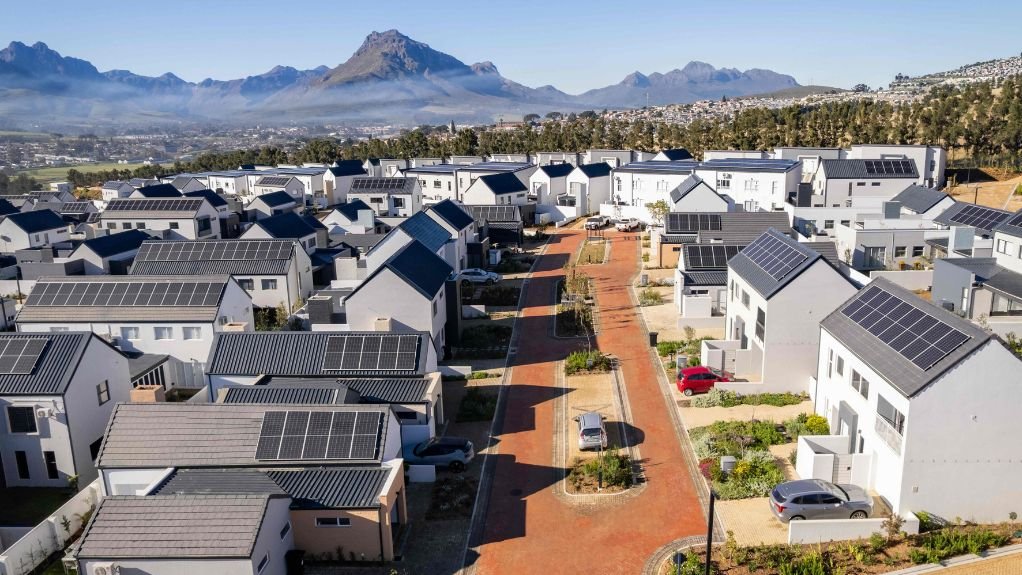

ECONOMIC RESILIENCE Operational efficiency indicators are indicating that green buildings are more resilient in quite a tough economy
GEORGINA SMIT Green buildings are more resilient in a tough economy, owing to improved utility management and broader sustainability considerations




Green-certified office buildings continue to outperform non-certified assets across several key investment metrics, says sustainability-focused property sector body Green Building Council South Africa (GBCSA) CEO Georgina Smit.
Citing findings from the MSCI South Africa Green Annual Property Index and the Guide to Costs and Trends, she adds that these metrics include total return, income per square metre and vacancy rates.
Operational efficiency indicators are also stronger, showing that “green buildings are more resilient in quite a tough economy”, which Smit attributes to improved utility management and broader sustainability considerations.
Certified buildings are rated using a Green Star system, which assesses multiple factors, such as energy and water use efficiency, as well as indoor air quality, daylight access and user wellbeing, that are of relevance to tenants.
There is a persistent view that green buildings are significantly more expensive, she says, noting that the council commissioned independent research by the University of Pretoria using project financial data. The data revealed that, while “going green can cost more,” particularly for specialised designs, this is not the norm.
“On average, going green does not have to be cost prohibitive,” she says, explaining that the research shows an average cost premium of about 2.2%, with some projects as low as 0.5%. This contrasts with earlier assumptions of costs being 10% to 20% higher.
Multiple Certification Options
GBCSA offers multiple certification systems to suit different market segments.
As a starting point, focused on energy, water and materials, Smit describes EDGE as “really focus[ing] on the fundamentals”.
For more advanced requirements, Green Star “would be the gold standard for sustainability in South Africa”, as it includes broader considerations such as resilience, community impact and operational performance.
The system also evaluates buildings during operation, as it considers actual energy use and water consumption, Smit explains.
Meanwhile, the recent Version 2 update to Green Star for New Buildings and Major Refurbishments resulted in more accessible language to broaden industry participation.
“We have reframed Green Star so that it tells a more digestible story,” she says.
The updated tool strengthens social and human-focused criteria, such as labour practices, inclusive design and user wellbeing. It also introduces minimum performance requirements and a clear pathway towards net-zero carbon.
Regarding skills development, Smit says the GBCSA Academy provides training across certification systems and tools, as its programmes can be tailored to specific industry roles.
She also highlights initiatives such as the Women in Green Building programme, developed with the International Finance Corporation, which helps women gain the requisite skills set to “take technical conversations further”. Student-focused programmes are also contributing to sector development by encouraging innovation and facilitating graduates’ entry into the sector.
Public-Sector Involvement
Smit says the Department of Public Works and Infrastructure has committed to advancing green building policies, which is noteworthy, as government owns and manages a large property portfolio.
“Green building principles need to be part of government’s standard practice,” she adds.
Further, despite there being sufficient industry capacity to support broader implementation, Smit identifies several barriers to adoption, such as the ongoing perception that green buildings are costly and lack of awareness around how many successful green certified projects in this country are case studies to inspire climate action.
She recommends “a greater alignment among stakeholders outside of the green building world on what industry uses to define a green building”.
A further challenge is the lack of municipal incentives, with limited financial or non- financial benefits for developers adopting green practices. Smit cites a municipal incentive policy that was introduced in eThekwini, that has yet to be implemented.
Banks and international funding programmes have played a role in driving adoption, with rebates linked to certified buildings “a huge driver”, particularly over the past three to four years.
She concludes that stronger municipal support, including non-financial incentives, such as faster approvals, could accelerate uptake.
Article Enquiry
Email Article
Save Article
Feedback
To advertise email advertising@creamermedia.co.za or click here
Research Reports

Projects


Latest Multimedia

Latest News

Showroom

ESAB South Arica, the leading supplier of high-end welding and cutting products to the Southern African industrial market is based in...
VISIT SHOWROOM
Developed to exceed the latest EN 15964 standards for police breathalysers proving that it will remain accurate and reliable for many years to come.
VISIT SHOWROOM



Announcements
What's On
Subscribe to improve your user experience...
Option 1 (equivalent of R125 a month):
Receive a weekly copy of Creamer Media's Engineering News & Mining Weekly magazine
(print copy for those in South Africa and e-magazine for those outside of South Africa)
Receive daily email newsletters
Access to full search results
Access archive of magazine back copies
Access to Projects in Progress
Access to ONE Research Report of your choice in PDF format
Option 2 (equivalent of R375 a month):
All benefits from Option 1
PLUS
Access to Creamer Media's Research Channel Africa for ALL Research Reports, in PDF format, on various industrial and mining sectors
including Electricity; Water; Energy Transition; Hydrogen; Roads, Rail and Ports; Coal; Gold; Platinum; Battery Metals; etc.
Already a subscriber?
Forgotten your password?
Receive weekly copy of Creamer Media's Engineering News & Mining Weekly magazine (print copy for those in South Africa and e-magazine for those outside of South Africa)
➕
Recieve daily email newsletters
➕
Access to full search results
➕
Access archive of magazine back copies
➕
Access to Projects in Progress
➕
Access to ONE Research Report of your choice in PDF format
RESEARCH CHANNEL AFRICA
R4500 (equivalent of R375 a month)
SUBSCRIBEAll benefits from Option 1
➕
Access to Creamer Media's Research Channel Africa for ALL Research Reports on various industrial and mining sectors, in PDF format, including on:
Electricity
➕
Water
➕
Energy Transition
➕
Hydrogen
➕
Roads, Rail and Ports
➕
Coal
➕
Gold
➕
Platinum
➕
Battery Metals
➕
etc.
Receive all benefits from Option 1 or Option 2 delivered to numerous people at your company
➕
Multiple User names and Passwords for simultaneous log-ins
➕
Intranet integration access to all in your organisation